agent007
You're in! See your latest actions or visit profile and dashboard
Account Information
Dashboard
March for Babies Dashboard

  • agent007
  • Preferences
  • Messages
  • Favorites

Prenatal care

  • Prenatal care is the care you get while you’re pregnant.
  • Regular prenatal care helps keep you and baby healthy.
  • A doctor, midwife or other health provider gives this care.
Now playing:
  • Overview
  • Q&A
  • In depth
share | e-mail | print |save |rate

E-mail to a friend

We will never share or sell your
e-mail.

Your information:


Your recipient's information:

You can send to a max of 5 people.
Separate addresses with commas.

Your message:


Privacy Policy    

Thank you!

Your e-mail was sent.

Save to my dashboard

Sign in or Sign up to save this page.  

Saving

Just a moment, please.

You've saved this page

It's been added to your dashboard.

Rate this page

Sign in or Sign up to rate this page.  

How helpful is this?

Thank you!

Sorry!

Click on the stars below. Thank you for taking the time to rate this page. You can only rate this page once in a 24 hour period.
  • 1 *1*
  • 2 *2*
  • 3 *3*
  • 4 *4*
  • 5 *5*

[submit]

Vaccinations during pregnancy

Some infections can harm you and your baby during pregnancy. This is why vaccinations are so important. They help protect your body from infection. You pass this protection to your baby during pregnancy. This helps keep your baby safe during the first few months of life until he gets his own vaccinations.

Vaccinations also protect you from getting a serious disease that could affect future pregnancies. Talk to your health care provider to make sure all your vaccinations are up to date. You probably got vaccinations as a child. But they don’t all protect you for your whole life. Or there may be new vaccinations that weren’t available when you were young. Over time, some childhood vaccinations stop working, so you may need what’s called a booster shot as an adult.

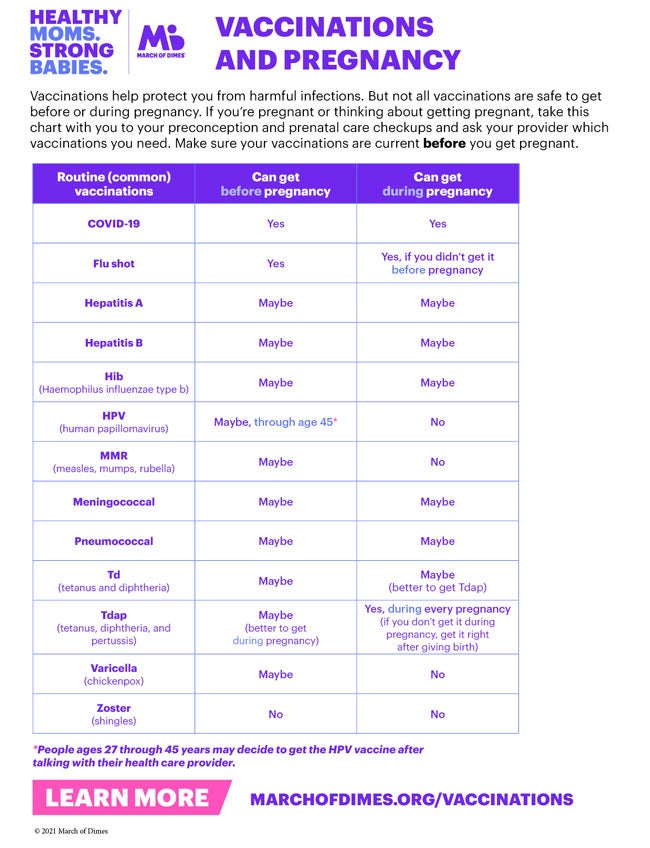
Not all vaccinations are safe to get during pregnancy. Here’s a chart to help you know when you can get certain vaccinations if you need them. Talk to your health care provider about vaccinations you need before, during or after pregnancy.


What vaccinations are recommended before pregnancy?
The U.S. Department of Health and Human Services (DHHS) recommends that you be up to date on all routine adult vaccinations before you get pregnant.

If you’re planning pregnancy, get a preconception checkup. This is a medical checkup you get before pregnancy.

At your checkup, ask your health care provider if you need any vaccinations or boosters. If you have a copy of your vaccinations record, bring it to your preconception checkup. If you don’t have a copy, your provider can do a simple blood test to find out what you need. If you do need any vaccinations, wait 1 month after you get any shot before trying to get pregnant.

Here are some vaccines that are recommended before pregnancy:

  • Flu. Get the flu shot once a year during the flu season (October through May). It protects you and your baby against both seasonal flu and H1N1, a kind of flu that spread around the world in 2009. If you come down with the flu during pregnancy, you’re more likely than other adults to have serious complications, such as pneumonia.
  • HPV. This vaccine protects against the infection that causes genital warts. The infection also may lead to cervical cancer. The CDC recommends that women up to age 26 get the HPV vaccine.
  • MMR. This vaccine protects you against the measles, mumps and rubella. Measles can be harmful to pregnant women and cause miscarriage.
  • Tdap. This vaccine is recommended for caregivers, close friends and relatives who spend time with your baby. It prevents pertussis (also called whooping cough). Pertussis is easily spread and very dangerous for a baby. If you're thinking about getting pregnant, ask your provider about getting the Tdap vaccine. It protects you from getting pertussis so you don't give it to your baby. 
  • Varicella. Chickenpox is an infection that causes itchy skin, rash and fever. It’s easily spread and can cause birth defects if you get it during pregnancy. It’s also very dangerous to a baby. If you’re thinking about getting pregnant and you never had the chickenpox or the vaccine, tell your provider.

What vaccinations are recommended during pregnancy?
The Centers for Disease Control and Prevention (CDC) recommends two vaccinations during pregnancy:

  1. Flu vaccine if you weren't vaccinated before pregnancy
  2. Tdap vaccine during each pregnancy at 27 to 36 weeks

If you come in contact with certain illnesses or if you’re at high risk for infection, your provider may recommend other vaccinations during pregnancy. These include:

  • Anthrax
  • Japanese encephalitis
  • Polio
  • Rabies
  • Vaccinia (smallpox)
  • Yellow fever

What vaccinations are not recommended during pregnancy?
Don’t get these vaccines during pregnancy:

  • BCG (tuberculosis)
  • Memingococcal
  • MMR
  • Nasal spray flu vaccine (called LAIV) (Pregnant women can get the flu shot, which is made with killed viruses.)
  • Typhoid
  • Varicella

Wait at least 1 month after getting any of these vaccinations before you try to get pregnant.

What vaccinations are recommended after pregnancy?
If you didn’t catch up on vaccinations before or during pregnancy, do it after your baby’s born. This can help protect you from diseases in future pregnancies.

If you didn’t get the Tdap vaccine before or during pregnancy, you can get it right after you give birth. Getting the Tdap vaccine soon after giving birth prevents you from getting pertussis and passing it on to your baby. Your baby should get his first pertussis vaccine at 2 months old. Babies may not be fully protected until they’ve had three doses.

Until your baby gets his first pertussis shot, the best way to protect him is to get the vaccine yourself and avoid people who may have the illness. Caregivers, close friends and relatives who spend time with your baby should get vaccinated, too.

Getting vaccinated soon after giving birth can help prevent your newborn baby from getting other illnesses, too. This is because most babies don’t begin their regular vaccination schedule until 2 months of age. By you getting vaccinated, you can avoid getting sick and, in turn, passing an illness to your baby.

If you’re breastfeeding, it’s safe for you to get routine adult vaccines. Ask your provider if you have questions.

Do vaccinations cause autism?
No. Vaccinations do not cause autism.

Some people are concerned that thimerosal, a chemical that has mercury in it and is used in some vaccines, causes autism. This concern came from a study done many years ago. The research in that study was flawed.

Since then, much careful research shows that thimerosal in vaccines did not cause autism. Thimerosal is no longer used in vaccines, except in tiny amounts in some flu shots. You can get a thimerosal-free flu vaccine if you want. Talk to your provider if you’re concerned about thimerosal in vaccines.

Last reviewed February 2013

See also: Your baby’s vaccinations, Later prenatal care checkup

Are you a CineMama?

Get the free iPhone app and make your own pregnancy video.

Most common questions

What is transabdominal ultrasound?

When you hear about ultrasound during pregnancy, it’s most likely a transabdominal ultrasound. This is a prenatal test that uses sound waves to show a picture of your baby in the uterus (womb). Your health care provider uses it to check your baby’s health. Most women get an ultrasound at 18 to 20 weeks of pregnancy.

During an ultrasound, your provider moves a plastic tool, called a transducer, across your belly. The transducer sends sound waves into your uterus. The waves bounce around to create a picture of your baby on a monitor. To get a better picture, your provider covers your belly with a thin layer of gel. This helps the sound waves move more easily.

Your provider measures your baby’s body throughout the test. Depending on your baby’s position, your provider may point out his hands, legs and other body parts. You should be able to tell if your baby’s a boy or a girl, so be sure to tell your provider if you don’t want to know!

You may need to have a full bladder during the test. This prevents pockets of air in your bladder from affecting the picture. Ultrasound is painless, but having a full bladder may be uncomfortable.

What is first trimester ultrasound?

First-trimester ultrasound (also called early ultrasound) is a prenatal test that uses sound waves to show a picture of your baby in the uterus (womb). Some providers may use this kind of ultrasound to make sure your baby’s organs are growing and developing normally.

Your health care provider uses it to check your baby’s health. A first-trimester ultrasound takes place before 14 weeks of pregnancy.

The kind of first-trimester ultrasound you have depends on the type of information your provider needs. Your provider usually does ultrasound by moving a plastic tool, called a transducer, across your belly. This is called . You also can have a , which means it’s done in the vagina (birth canal). Both kinds usually take about 15 to 20 minutes.

Your provider can use first-trimester ultrasound to:

See also: Ultrasound

What is 4-D ultrasound?

4-D ultrasound is a prenatal test that uses sound waves to show a three-dimensional picture of your baby in the uterus (womb) and shows your baby’s movement. 3-D images are almost as clear as a photograph, and 4-D is a moving-picture version or video. Some providers may use this kind of ultrasound to make sure your baby’s organs are growing and developing normally.

You may know of some places, like stores in a mall, that aren’t run by doctors or other medical professionals that offer “keepsake” 3-D or 4-D ultrasound pictures or videos for parents. The American College of Obstetricians and Gynecologists, the Food and Drug Administration and the American Institute of Ultrasound in Medicine do not recommend these non-medical ultrasounds. The people doing them may not have medical training and may give you wrong or even harmful information.

What is 3-D ultrasound?

3-D ultrasound is a prenatal test that uses sound waves to show a three-dimensional picture of your baby in the uterus (womb). Some providers may use this kind of ultrasound to make sure your baby’s organs are growing and developing normally.

The 3-D ultrasound is almost as clear as a photograph. A moving-picture version is called 4-D ultrasound.

You may know of some places, like stores in a mall, that aren’t run by doctors or other medical professionals that offer “keepsake” 3-D or 4-D ultrasound pictures or videos for parents. The American College of Obstetricians and Gynecologists, the Food and Drug Administration and the American Institute of Ultrasound in Medicine do not recommend these non-medical ultrasounds. The people doing them may not have medical training and may give you wrong or even harmful information.

See also: Ultrasound

What is Doppler ultrasound

Doppler ultrasound is a kind of prenatal test that can be used to check a baby’s health in high-risk pregnancies. Providers usually use Doppler ultrasound during the last trimester, but it may be done earlier.

During Doppler ultrasound, your provider uses a plastic tool called a transducer to measure the blood flow in the umbilical cord and some of your baby’s blood vessels. This test shows if your baby is getting enough oxygen. Your provider also can listen to your baby’s heartbeat using Doppler ultrasound.

Some providers use Doppler ultrasound to check mothers with Rh disease. This is a condition where a difference between the mother’s blood and baby’s blood can cause a dangerous kind of anemia in the baby. Anemia is when the body doesn’t have enough red blood cells or the red blood cells are too small. When the condition is found early and treated, most affected babies survive.

What is transvaginal ultrasound?

Transvaginal ultrasound is a prenatal test that uses sound waves to show a picture of your baby in the uterus (womb). Your health care provider uses transvaginal ultrasound to check your baby’s health. It’s often used for early ultrasound in the first trimester.

During the test, your provider moves a thin, wand-like transducer into the vagina. You lay on your back with your feet in stirrups during the exam. You may feel some pressure from the transducer, but it shouldn’t cause pain.

Transvaginal ultrasound can be used throughout pregnancy to check for problems with the cervix (opening to the uterus) and lower uterus.

See also: Ultrasound

How is blood pressure measured?

Blood pressure is the force of blood that pushes against the walls of your arteries. Arteries are blood vessels that carry blood away from your heart to other parts of the body. If the pressure in your arteries becomes too high, you have high blood pressure. High blood pressure is also called hypertension.

At each prenantal care visit, your health care provider checks your blood pressure. To do this, she wraps an inflatable cuff around your upper arm. She pumps air into the cuff to measure the pressure in your arteries when the heart contracts (gets tight) and then relaxes.

Your blood pressure reading is given as two numbers: the top (first) number is the pressure when your heart contracts and the bottom (second) number is the pressure when your heart relaxes. A healthy blood pressure is 110/80. High blood pressure happens when the top number is 140 or greater, or when the bottom number is 90 or greater

Your blood pressure can go up or down during the day. Your provider can re-check a high reading to find out if you have high blood pressure during pregnancy.

Last reviewed March 2012

See also: High blood pressure during pregnancy, Preeclampsia, HELLP syndrome

Can a rubella shot hurt my baby during pregnancy?

If you got your rubella shot around the time you got pregnant, it's unlikely that your baby will be harmed by the vaccine. However, it's best to wait to get pregnant for 28 days after vaccination because there is a very small risk of potentially hurting the baby. To date, there hasn't been any birth defects reported that are attributed to the rubella vaccine. In any case, the risk of harming your baby by getting the vaccine at the time you got pregnant is much lower than the risk of harming your baby if you caught rubella during pregnancy.

I couldn't see my baby at my 7 week ultrasound. Why?

At the 7th week of pregnancy, your baby is about ½ an inch long or the size of a blueberry. He's very small. When a transabdominal ultrasound (done on your belly) is done at such an early stage, it's possible that the baby can't be seen. It could be because it's too early in the pregnancy or because you conceived a little later than what you thought. Your health care provider might recommend a transvaginal ultrasound (done inside the vagina) to help see the baby more clearly.

What are choroid plexus cysts?

The choroid plexus is the area of the brain that produces the fluid that surrounds the brain and spinal cord. This is not an area of the brain that involves learning or thinking. Occasionally, one or more cysts can form in the choroid plexus. These cysts are made of blood vessels and tissue. They do not cause intellectual disabilities or learning problems. Using ultrasound, a health care provider can see these cysts in about 1 in 120 pregnancies at 15 to 20 weeks gestation. Most disappear during pregnancy or within several months after birth and are no risk to the baby. They aren't a problem by themselves. But if screening tests show other signs of risk, they may indicate a possible genetic defect. In this case, testing with higher-level ultrasound and/or amniocentesis may be recommended to confirm or rule out serious problems.

Have questions?

Amniocentesis

Amniocentesis (also called amnio) is a common prenatal test used to diagnose certain birth defects and genetic conditions. Genetic conditions are health conditions and birth defects that are passed down to a baby from mom and dad. They may cause health problems for a baby.

Amnio is different from another prenatal test called . Talk to your health care provider about having an amnio, CVS or other prenatal tests.

The American College of Obstetricians and Gynecologists (ACOG) recommends that all pregnant women should have the option of having prenatal tests like amniocentesis. Your provider may recommend you have an amnio if you are at risk for having a baby with a birth defect. Most women who have an amnio find out their baby is fine.

During an amnio, your health care provider takes a small sample of amniotic fluid. Amniotic fluid is fluid that surrounds your baby in the womb. The sample is used to check your baby’s health.

It’s best to have an amnio in the second trimester between 15 and 20 weeks of pregnancy. Amniocentesis before 15 weeks is no longer recommended because it has a higher risk of miscarriage and other complications. A third-trimester amniocentesis can find infections in your uterus (womb) or check to see if your baby’s lungs are developed enough for early birth.

What are some reasons for having an amnio?
Your provider should offer you an amnio, and you can ask to have one. You may want to have an amnio if you’re at risk for having a baby with a birth defect. These risks include:

  • Being 35 or older. The risk of having a baby with certain birth defects, such as Down syndrome, increases as you get older.
  • Having a previous child or pregnancy with a birth defect. If you had a child or a pregnancy with a birth defect in the past, your provider should offer you testing.
  • Abnormal screening test results. A screening test is usually a blood test that checks to see if you or your baby is more likely than others to have a certain health condition. It's different from a diagnostic test that tells you if you do or do not have a certain health condition. If you have abnormal results from a screening test, your provider should offer you amniocentesis. Most babies with abnormal screening test results are born healthy.
  • Family history of a genetic condition. If you, your partner, or a member of either of your families has a genetic condition, such as cystic fibrosis or sickle cell disease, you may want to have an amnio.

How is the test done?
Amniocentesis takes a few minutes.

First, your health care provider asks you to lie flat on your back. He uses ultrasound to find your baby, the placenta and pockets of amniotic fluid. He then cleans your belly with an antibacterial liquid that destroys germs on your skin.

Next, using ultrasound as a guide, your provider puts a thin needle through your belly and uterus into the amniotic sac. He uses the needle to remove about 1 to 2 tablespoons (1 ounce) of fluid.

Once the fluid sample is taken, your health care provider uses the ultrasound to check that your baby’s heartbeat is healthy.

The amniotic fluid sample is sent to a lab, where it is examined and tested. In the lab, your baby’s cells are separated from the amniotic fluid. If your baby is being tested for genetic problems, the cells are grown for about 10 to 12 days at the lab so that there are enough to check for problems. Test results usually are available within 2 weeks.

The lab may test your baby’s amniotic fluid for proteins like alpha fetoprotein (AFP). Measuring the amount of AFP can check if your baby has neural tube defects (NTDs). The neural tube is the part of a developing baby that becomes the brain and spinal cord. AFP levels are often higher if your baby has an NTD. AFP test results usually are available in a few days.

Are there any risks to having an amnio?
Some women find that having an amnio is painless. Others feel cramping when the needle enters the uterus, or pressure when the fluid is removed. One to 2 out of 100 women (1 to 2 percent) have cramping, spotting or leaking amniotic fluid after the test. Your provider may tell you to avoid intense activity and take it easy for the rest of the day.

Serious complications from amniocentesis are rare. However, the test does involve a small risk of miscarriage. According to ACOG, less than 1 in 200 women (less than 1 percent) have a miscarriage after amniocentesis.

What happens after the test?
In most cases, amnio results show that a baby is healthy and without birth defects. If the test shows that your baby does have a birth defect, talk to your provider about your options. For example, your baby may be able to be treated with medicines or even surgery before birth. Or there may be treatments or surgery he can have after birth. Knowing about a birth defect before birth may help you get ready emotionally to care for your baby. You also can plan your baby’s birth with your health care provider to make sure she gets any special care she needs right after she’s born.

What if you’re not sure about having an amnio?
Choosing to have an amnio is a personal decision. Talking with genetic counselors, your health care provider, and religious and spiritual leaders can help you make decisions about testing for birth defects during pregnancy.

Ask your provider about other prenatal test options and how you can find a doctor who is trained and experienced in offering specific tests. Learn as much as you can about any prenatal tests your provider recommends to make the right decisions for you and your baby.

How can you reduce risk of birth defects?
Learn what you can do to get healthy before and during pregnancy to help reduce your risk for birth defects and improve your chances of having a healthy pregnancy and a healthy baby.

Last reviewed October 2012

Amniotic fluid

Amniotic fluid is the fluid that surrounds your baby in your uterus (womb). It’s very important for your baby’s development.

How does amniotic fluid keep your baby healthy?
During pregnancy, your uterus is filled with amniotic fluid. Here’s what the fluid does:

  • Cushions and protects your baby
  • Keeps a steady temperature around your baby
  • Helps your baby’s lungs grow and develop because your baby breathes in the fluid
  • Helps your baby’s digestive system develop because your baby swallows the fluid
  • Helps your baby’s muscles and bones develop because your baby can move around in the fluid
  • Keeps the umbilical cord (the cord that carries food and oxygen from the placenta to your baby) from being squeezed

The amniotic sac (bag) inside the uterus holds your growing baby. It is filled with amniotic fluid. This sac forms about 12 days after getting pregnant.

In the early weeks of pregnancy, the amniotic fluid is mostly water that comes from your body. After about 20 weeks of pregnancy, your baby’s urine makes up most of the fluid. Amniotic fluid also contains nutrients, hormones (chemicals made by the body) and antibodies (cells in the body that fight off infection).

How much amniotic fluid should there be?
The amount of amniotic fluid increases until about 36 weeks of pregnancy. At that time, it makes up about 1 quart. After that, the amount of amniotic fluid usually begins to decrease.

Sometimes you can have too little or too much amniotic fluid. Too little fluid is called oligohydramnios. Too much fluid is called polyhydramnios. Either one can cause problems for a pregnant woman and her baby. Even with these conditions, though, most babies are born healthy.

Does the color of amniotic fluid mean anything?
Normal amniotic fluid is clear or tinted yellow. Fluid that looks green or brown usually means that the baby has passed his first bowel movement (meconium) while in the womb. (Usually, the baby has his first bowel movement after birth.)

If the baby passes meconium in the womb, it can get into his lungs through the amniotic fluid. This can cause serious breathing problems, called meconium aspiration syndrome, especially if the fluid is thick.

Some babies with meconium in the amniotic fluid may need treatment right away after birth to prevent breathing problems. Babies who appear healthy at birth may not need treatment, even if the amniotic fluid has meconium.

June 2010

Carrier screening for cystic fibrosis

Cystic fibrosis (CF) is a genetic (inherited) disease. About 30,000 children and adults in the United States have the disorder. Cystic fibrosis severely affects breathing and digestion. It is caused by an abnormal gene that makes the body produce thick mucus in the lungs. This mucus promotes infections that are often life threatening. In the pancreas, similar thick secretions can lead to serious problems with food absorption. People with CF usually survive into their 30s. Researchers continue to search for more effective CF treatments as well as a cure.

CF carrier testing is a blood or saliva test. It checks to see if parents-to-be have (carry) the abnormal gene that causes CF. The test can help determine if you're at increased risk for having a child with CF.

The only way to get CF is to have two genes that cause CF—one from your mother and one from your father. This means that both parents are CF carriers. A CF carrier has only one CF gene and has no CF symptoms. You could inherit the CF gene from one of your parents and never even know it.

If only one parent from a couple is a CF carrier, none of the children will have CF. But there is a 50-50 chance that each child will be a symptomless carrier.

When both parents carry the CF gene, there is a 25% chance (1 in 4) that their child will have CF. There is a 50-50 chance that the child will be a carrier like the parents. And there is a 25% chance that the baby will not have the gene—not a carrier and not have the disease.

Are you or your baby's father likely to be a CF carrier?
Approximately 1 in 30 Americans is a symptomless carrier of the CF gene. If you have a family history of CF, you're more likely to carry the gene than someone from an unaffected family.

The risk is increased if you're of Caucasian background. If so, you have a 1-in-29 chance of carrying the gene, compared to 1-in-46 for people of Latino background, 1-in-65 for African-Americans, and 1-in-90 for Asian-Americans.

Remember that the only way you can pass CF to your baby is if both you and the baby's father have the CF gene. Luckily, this is pretty rare.

If test results show that both parents are CF carriers, your health care provider can test the baby in utero. If the baby has CF, parents can take time before delivery to learn more about the disease and find appropriate specialists.

The American College of Obstetricians and Gynecologists (ACOG) recommends that health care providers make the CF carrier screening test available to all couples. Deciding whether or not to have the test is your own personal choice. Talk it over with your partner and with your health care provider and get as much information as you need to decide what's right for you and your baby.

March 2006

Chorionic villus sampling

Chorionic villus sampling (CVS) is a prenatal test. It’s used to diagnose certain birth defects and genetic abnormalities in your baby. Genetic abnormalities are changes in the genes that are passed down to a baby from mom or dad. These genetic changes can cause health problems for a baby.

During CVS, your health care provider takes a small piece of tissue from the placenta. The sample is used to check your baby’s health.

You can get CVS early in pregnancy, between 10 and 12 weeks. CVS isn’t given to all pregnant women because there’s a small chance of miscarriage after the test.

CVS is different from another prenatal test called amniocentesis (also called amnio). Amnio is performed a little later in pregnancy. Talk to your provider about having CVS, amnio or other prenatal tests.

What are some reasons for having CVS?
Your provider should discuss prenatal testing with you and may offer you CVS. And you can ask to have CVS. You may want to have CVS if you’re at risk for having a baby with a genetic abnormality. These risks include:

  • Being 35 or older: The risk of having a baby with certain birth defects or genetic abnormalities, such as Down syndrome, increases as you get older.
  • Having a previous child or pregnancy with a birth defect: If you had a child or a pregnancy with a birth defect in the past, your provider should offer you testing.
  • Abnormal screening test results: If you had abnormal results from a pregnancy screening test, your provider should discuss CVS with you. CVS can provide specific information to confirm if there is an abnormality in the baby. Most babies with abnormal screening test results don’t have problems and are born healthy.
  • Family history of a genetic health problem: If you or your partner has a certain genetic disease (a health condition that gets passed down to a baby from mom or dad), or a close family member with a disease, such as cystic fibrosis or sickle cell anemia, you may want to have CVS.

How is the test done?
The test usually takes 30 to 45 minutes.

A health care provider with expertise in performing CVS takes a tiny piece of tissue from the placenta, which has cells from your baby, to check for problems. The placenta grows with your baby in your uterus (womb). It gives your baby food and oxygen through the umbilical cord.

There are two kinds of CVS:

  1. Testing through the belly (called transabdominal CVS) — Your provider puts a thin needle through your belly into the womb. She then uses the needle to take a small sample of the placenta tissue.
  2. Testing through the cervix (called transcervical CVS) — Your provider places a thin tube through your vagina and cervix (the opening to the uterus that sits at the top of the vagina). The tube gently sucks in a tiny sample of the placenta tissue.

Your provider sends the tissue sample to a lab where it is examined and tested. Test results are usually ready in about 7 days.

Are there any side effects or risks?
Some women find that CVS is painless. Others feel cramping, similar to period cramps, when the sample is taken. Some women who have testing through the cervix say it feels like having a Pap smear.

After CVS, relax for the rest of the day. You may have spotting or cramping for a few hours after the test. Call your health care provider right away if you have heavy bleeding, fever or contractions.

CVS does involve a small risk of miscarriage. The American College of Obstetricians and Gynecologists (ACOG) reports that 1 in 100 (1 percent) women has a miscarriage following testing.

What happens after the test?
In most cases, CVS test results show that a baby is healthy and without birth defects. If the test shows that your baby does have a birth defect, talk to your provider about all of your options. Your baby may be able to be treated with medicines or even surgery before birth. Or there may be treatments or surgery he can have after birth.

Knowing about a birth defect before birth may help you get ready emotionally to care for your baby. You also can plan your baby’s birth with your health care provider. This way, your baby can get any special care she needs right after she is born.

What if you’re not sure about having CVS?
Choosing to have CVS is a personal decision. Talking with genetic counselors, your health care provider, and religious and spiritual leaders can help you make decisions about testing for birth defects during pregnancy.

Ask your provider about other prenatal test options and how you can find a doctor who is trained and experienced in offering specific tests. Learn as much as you can about any prenatal tests your provider recommends to make the right decisions for you and your baby.

Last reviewed August 2011

See also: Your first prenatal checkup, Later prenatal checkups, Birth defects, Amniocentesis, Prenatal tests

Glucose screening

Who: All pregnant women.

Why: To check for gestational diabetes (diabetes during pregnancy).

When: Between 24 and 28 weeks of pregnancy.

How: The health care provider takes a blood sample 1 hour after the woman consumes a drink containing glucose (a form of sugar).

If the screening test shows high blood sugar levels, the woman will need to take a diagnostic test to find out if she has gestational diabetes. The diagnostic test takes 3 hours.

Risks: Possible bruising or soreness at the needle site.

November 2008

Later prenatal checkups

It’s important to keep seeing your health care provider during pregnancy. Regular prenatal care can help you have a healthy pregnancy and baby.

What is your prenatal care schedule?
If your pregnancy is healthy, you may be able to follow a schedule like this:


If you have a health problem during pregnancy, your provider may want to see you more often. Make sure you go to all of your prenatal care checkups even if you’re feeling fine.

What happens at your prenatal care checkups?
Your first prenatal care checkup is usually the longest because your provider asks you lots of questions and does several tests. Later prenatal care checkups may be much shorter.

At later prenatal checkups, your provider:

  • Checks your weight.
  • Takes your blood pressure.
  • Measures your belly to see how your baby is growing (second and third trimesters).
  • Checks your hands, feet and face for swelling.
  • Listens for the baby's heartbeat (after the 12th week of pregnancy).
  • Feels your belly to find your baby's position (later in pregnancy).
  • Does tests, such as blood tests or ultrasound.
  • Talks to you about your questions or concerns. It's a good idea to write down your questions and bring them with you so you don't forget what to ask!

During your first prenatal checkup, your provider talked to you about your family health history. As you continue your prenatal checkups, keep learning more about it.

If you find something new, or have a question for your health provider, write it down. You can talk to your health provider at your next visit.

Also, go to all your prenatal checkups, even if you’re feeling fine!

Who else knows about your health information?
Your health care provider may have you answer health questions to find out about your health history and the health of your family members related to you by blood. She may have you answer these questions using a paper form or a computer while you’re in the waiting room.

It can be hard sharing such personal information, like if you had a sexually transmitted infection or if you use drugs. Know that the answers you give help your provider give you and your baby the best care.

All of the health information you share is private and safe. It doesn’t matter if the information comes from your prenatal tests, is written down in a paper form, gets added into a computer or is shared during a talk you have with your provider. Only your health care team knows your health information.

So, don’t be afraid to give honest answers or share your concerns with your provider. She can’t tell anyone else what you say without your permission.

How can you get free or low-cost prenatal care?
If you don't have insurance or can't afford prenatal care, find out about free or low-cost services in your area:

  • Call (800) 311-BABY (800-311-2229). This toll-free number connects you to your local health department.
  • For information in Spanish, call 800-504-7081.

Last reviewed May 2011

See also: First prenatal care checkup, Routine prenatal tests

Maternal blood screening

Who: Offered to all pregnant women.

Why: To identify pregnancies at higher-than-average risk of certain serious birth defects, including neural tube defects, like spina bifida, and chromosomal abnormalities like Down syndrome.

When: First or second trimester.

How: Blood is taken from a woman's arm. The laboratory measures levels of certain substances in the mother's blood.

Risks: A little bruising or soreness at the needle site. Most abnormal test results are false alarms. Women with abnormal test results are usually offered further testing, such as ultrasound.

November 2008

Prenatal tests

Prenatal tests are medical tests you get during pregnancy. They help your health care provider find out how you and your baby are doing. Some of these tests, like blood pressure checks and urine tests, are routine. You get these at almost every checkup. You get other tests at certain times during pregnancy or only if you have certain problems. Talk to your provider about which test you should have.

What prenatal tests are done in the first trimester?
You can have several tests in your first trimester:

  • Chorionic villus sampling (CVS). Tests the tissue around the baby to see if he has a genetic condition, like Down syndrome. The test usually is done between 10 and 12 weeks of pregnancy. Your provider may want you to have CVS if you’re older than 35, if genetic problems run in your family, or if your first-trimester screening shows that your baby is at increased risk for birth defects.
  • Cystic fibrosis (CF) carrier screening. Tests to see if you have the gene that causes CF. CF is a disease that affects breathing and digestion. If you and your partner have the gene, you can pass CF to your baby. You and your partner can have this test any time during pregnancy.
  • Early ultrasound. Confirms (makes sure) that you’re pregnant. It also dates the pregnancy, so you know your baby’s age.
  • First-trimester screening. Tests your blood to see if your baby is at risk for some birth defects, like Down syndrome and heart defects. You get an ultrasound as part of this test. The test usually is done at 11 to 13 weeks of pregnancy.

What tests are done during the second trimester?
As you get further along in your pregnancy, your provider may offer you these prenatal tests:

  • Maternal blood screening. Tests your blood to see if your baby is at risk for some birth defects, like Down syndrome and heart defects. The test measures four substances in the mother's blood: alpha-fetoprotein (AFP), estriol, human chorionic gonadostropin (hCG) and inhibin A. The test is done at 15 to 20 weeks of pregnancy.
  • Amniocentesis. Also called amnio. Tests the amniotic fluid from around your baby to see if he has a genetic condition, like Down syndrome. The test usually is done at 15 to20 weeks of pregnancy. Your provider may want you to have an amnio for the same reasons as for CVS.
  • Ultrasound. Helps your provider make sure your baby is growing and check for birth defects. It’s usually done at 18 to 20 weeks of pregnancy.
  • Glucose screening. Tests to see if you have gestational diabetes. This is a kind of diabetes that some women get during pregnancy. The test is done 24 to 28 weeks of pregnancy.

What test is done during the third trimester?
In your last trimester, your provider does a test for group B strep (also called GBS). Group B strep is an infection you can pass to your baby during birth. The test checks fluid from your cervix to see if you have GBS. The test is done at 35 to 37 weeks of pregnancy.

Last reviewed August 2012

See also: Your first prenatal checkup, Later prenatal checkups, Vaccinations and pregnancy, Choosing your prenatal care provider


Ultrasound

Ultrasound (also called sonogram) is a prenatal test offered to most pregnant women. It uses sound waves to show a picture of your baby in the uterus (womb). It lets your provider check on your baby’s health and development.

Ultrasound can be a special part of pregnancy—it’s the first time you get to “see” your baby! Depending on when it’s done and your baby’s position, you may be able to see his hands, legs and other body parts. You may be able to tell if your baby’s a boy or a girl, so be sure to tell your provider if you don’t want to know!

Most women get an ultrasound at 18 to 20 weeks of pregnancy. You may get a first-trimester ultrasound (called an early ultrasound) to confirm your pregnancy (make sure you’re pregnant) and find out your due date.

What are some reasons for having an ultrasound?
Your health care provider uses ultrasound to check your baby’s growth and development and to help estimate your baby’s due date. Ultrasound checks for several things, including:

Are there different kinds of ultrasound?
Yes. The kind you get depends on what your provider is checking for and how far along you are in pregnancy. All ultrasounds use a tool called a transducer that uses sound waves to create pictures of your baby on a computer.

The most common kinds of ultrasound are:

  • Transabdomial ultrasound. When you hear about ultrasound during pregnancy, it’s most likely this kind. Your provider moves the transducer across your belly. To get a better picture, he covers your belly with a thin layer of gel. This helps the sound waves move more easily. The ultrasound takes about 20 minutes. You may need to have a full bladder during the test. This prevents pockets of air in your bladder from affecting the picture. Ultrasound is painless, but having a full bladder may be uncomfortable.
  • Transvaginal ultrasound. This kind is done in the vagina (birth canal). It also takes about 20 minutes. For this test, your bladder needs to be empty or just partly full. The ultrasound is painless, but you may feel some pressure from the transducer.

In special cases, your provider may get more information using other kinds of ultrasound, like:

  • Doppler ultrasound. This is used to check a baby’s blood flow if he’s not growing normally.
  • 3-D ultrasound. This takes thousands of pictures at once. It makes a 3-D image that’s almost as clear as a photograph.
  • 4-D ultrasound. This is like a 3-D ultrasound, but it also shows your baby’s movements.

Does ultrasound have any risks?
Ultrasound is safe for you and your baby when done by your health care provider. Because ultrasound uses sound waves instead of radiation, it’s safer than X-rays. Providers have used ultrasound for more than 30 years, and they have not found any dangerous risks.

If your pregnancy is healthy, ultrasound is good at ruling out problems, but not as good at finding them. It may miss some birth defects. Sometimes, a routine ultrasound may suggest that there is a birth defect when there really isn’t one. While follow-up tests often show that the baby is healthy, false alarms can cause worry for parents.

You may know of some places, like stores in a mall, that aren’t run by doctors or other medical professionals that offer “keepsake” 3-D or 4-D ultrasound pictures or videos for parents. The American College of Obstetricians and Gynecologists, the Food and Drug Administration and the American Institute of Ultrasound in Medicine do not recommend these non-medical ultrasounds. The people doing them may not have medical training and may give you wrong or even harmful information.

What happens after an ultrasound?
For most women, ultrasound shows that the baby is growing normally. If your ultrasound is normal, just be sure to keep going to your prenatal checkups.

Sometimes, ultrasound may show that you and your baby need special care. For example, if the ultrasound shows your baby has a heart problem, she may be able to be treated in the womb before birth. If the ultrasound shows certain birth defects or that your baby is breech (feet-down instead of head-down), you may need a cesarean section (c-section).

No matter what an ultrasound shows, talk to your provider about the best care for you and your baby.

More information
The March of Dimes has partnered with the American Institute of Ultrasound Medicine, Johns Hopkins University and Parents.com to create a unique peak into a baby's development inside the womb. These images reveal the details of a baby's growth from a collection of cells to a full-term newborn.

Last reviewed June 2012

See also: Your first prenatal care checkup, Later prenatal checkups

Your first prenatal care checkup

Congratulations on your pregnancy! Now that you know you’re expecting, it’s important to take very good care of yourself and your baby. The first thing you can do is make an appointment with your health care provider for your first prenatal care checkup.

Your first prenatal checkup is usually the longest because your provider asks you lots of questions and does several tests.

How do you get ready for your first prenatal checkup?
You might not be sure about what to expect at your first prenatal care checkup. It helps to plan ahead.

At your first prenatal checkup, your provider talks to you about your health. She may have you answer questions, like about your health history, using a paper form or computer while you’re in the waiting room. This helps your provider plan the best care for you and your baby.

Be prepared to tell your provider about:

Also, keep learning about your family health history. If you learn something new, or have a question for your health provider, write it down. You can talk to your health provider at your next visit. These steps will help you to have a healthy pregnancy and a healthy baby.

What else happens at the first prenatal care checkup?
At your first prenatal care checkup, your provider does some tests to check your health and your baby’s health. Your health care provider:

  • Checks your weight
  • Takes your blood pressure
  • Does a physical exam and a pelvic (internal) exam
  • Checks your urine sample for infection
  • Does some blood tests to check for anemia and to see if you have certain infections. You get a blood test for HIV, the virus that causes AIDS, unless you say no.
  • Does a Pap smear to check for cervical cancer and other tests for vaginal infections.
  • Gives you a prenatal vitamin with 600 micrograms of folic acid

Go to all your prenatal checkups, even if you’re feeling fine!

Who else knows about your health information?
It can be hard sharing such personal information, like if you had a sexually transmitted infection or if you use drugs. Know that the answers you give help your provider give you and your baby the best care.

All of the health information you share is private and safe. It doesn’t matter if the information comes from your prenatal tests, is written down in a paper form, gets added into a computer or is shared during a talk you have with your provider. Only your health care team knows your health information.

So, don’t be afraid to give honest answers or share your concerns with your provider. She can’t tell anyone else what you say without your permission.


This web article is supported by grant U33MC12786 from the Health Resources and Services Administration, Maternal and Child Health Bureau, Genetic Services Branch, as part of the Family Health History for Prenatal Providers project. Partners in the Family Health History for Prenatal Providers project include HRSA, March of Dimes Foundation, National Coalition for Health Professional Education in Genetics, Genetic Alliance and Harvard Partners.

See also: Later prenatal care checkups, Routine prenatal tests, Family health history

NICU Family Support®

Your gift helps provide comfort and support to families with a baby in the NICU.

Donation amount:

Get the app

Spread the word about March for Babies on Facebook and raise money online.